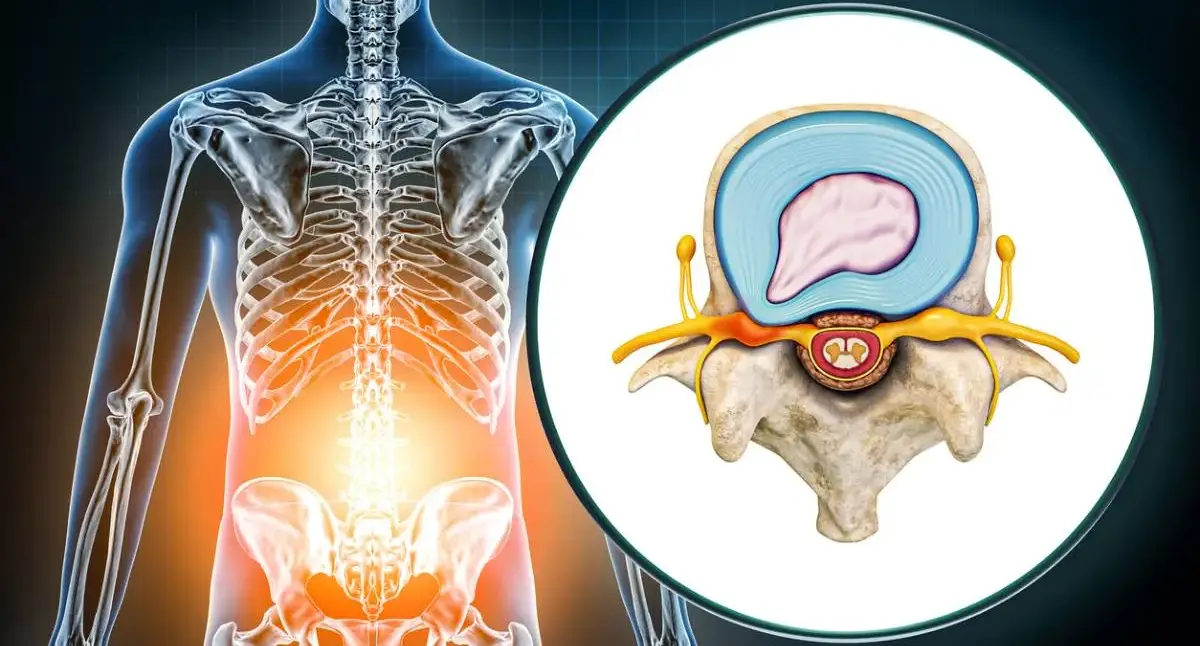



Many herniated discs get better without surgery, but radiating pain, numbness, or weakness may call for targeted treatment and a specialist evaluation.





You lift a grocery bag, get up from a low sofa, or sit through a long commute—and a sharp pull in your lower back turns into pain that shoots into your buttock or down your leg. If imaging showed a herniated disc, the next question is usually immediate and personal: can it go away without surgery?
In many cases, yes. A herniated disc can improve with time and the right plan. The key is knowing what “normal healing” looks like, which symptoms suggest nerve irritation that needs closer attention, and when it makes sense to meet with a spine specialist for more targeted treatment.
Your spine is a stack of vertebrae separated by discs—soft, shock-absorbing cushions that help you bend, twist, and carry weight. Each disc has a tougher outer ring and a softer inner center. A herniated disc happens when the outer ring weakens or tears and the inner material pushes outward.
The disc itself is not always the main source of pain. Symptoms often flare when the herniation irritates or compresses a nearby nerve root. That irritation can create “electric” or burning pain, tingling, numbness, or weakness that travels along the path of the nerve.
In the low back, disc-related nerve pain commonly shows up as sciatica—pain radiating from the back into the buttock and down the leg. In the neck, symptoms can travel into the shoulder, arm, or hand.
Many people recover without surgery, especially when symptoms are stable and there is no progressive neurologic deficit. In real life, “go away” often means your pain settles down, function returns, and you can get back to walking, working, sleeping, and exercising—even if an MRI still shows a disc bulge.
Non-surgical treatment aims to calm inflammation around the nerve, restore normal movement, and build support around the spine so the area is less likely to flare again. The right plan is structured and progressive, not just waiting and hoping.
If you were told you have a disc problem and want to learn more about the diagnosis itself, our pages on herniated disc treatment, disc protrusion, and disc extrusion can help clarify the terminology you may see on an MRI report.
Muscle soreness after activity is common. A herniated disc is more likely when back or neck pain is paired with nerve symptoms—especially symptoms that radiate away from the spine.
These symptoms overlap with other nerve-compression problems as well. If you suspect nerve involvement, you can also read about pinched nerve treatment and sciatica treatment.
If you are a good candidate for conservative care, the goal is to reduce nerve irritation while keeping you safely active. Many people do worse with long periods of inactivity, but they also flare if they keep pushing through the wrong movements. A thoughtful plan threads that needle.
Short-term easing off can help during an acute flare, but weeks of bed rest often backfire by increasing stiffness and deconditioning. Instead, many patients improve with “relative rest”: avoiding what clearly spikes symptoms (heavy lifting, repetitive bending, prolonged sitting) while continuing gentle movement like short walks, position changes, and light daily activity as tolerated.
Effective physical therapy is not random stretching. It focuses on restoring motion, strengthening core and hip support, improving posture and mechanics, and teaching positions that reduce nerve irritation. For some people, certain extension or flexion-based movements help; for others, those same movements aggravate symptoms. A good plan is specific to your presentation.
Ice can help in the early inflammatory phase, and heat can be useful when muscle spasm and tightness make it hard to move. These tools do not “reverse” a herniation, but they can lower pain enough to keep you moving and participating in rehab.
Depending on your medical history, your clinician may recommend anti-inflammatory medication or other pain-relieving strategies to improve function. The intent is to help you stay mobile and sleep—while the underlying nerve irritation calms—not to mask worsening neurologic symptoms.
Small changes add up: improving desk ergonomics, taking sitting breaks, learning safer lifting technique, and gradually building a walking routine. If excess weight is contributing to spinal load, steady weight management can also reduce stress on the low back.
For a broader overview of diagnoses that can mimic or overlap with disc symptoms, visit our hub on spine conditions.
Surgery is not the first step for most herniated discs, but it can be the right step when nerve compression is causing persistent pain or functional decline despite appropriate non-surgical care.
A spine evaluation is often appropriate when:
When a disc is clearly compressing a nerve and symptoms match the imaging, a common surgical option is spinal discectomy surgery, which removes the portion of disc pressing on the nerve. For appropriately selected patients, techniques within minimally invasive spine surgery may reduce muscle disruption and support a smoother early recovery.
One important clarification: kyphoplasty is typically used to treat certain vertebral compression fractures—not a routine herniated disc. If kyphoplasty has been mentioned in your case, it is worth confirming whether a fracture is part of the diagnosis; our page on compression fracture treatment explains when that procedure may be considered.
Some symptoms should not be watched at home. Seek urgent evaluation if you develop new or rapidly worsening weakness, severe symptoms after a fall or accident, or symptoms that escalate quickly over hours to days.
In addition, emergency evaluation is recommended if you experience loss of bowel or bladder control or numbness in the groin/saddle area, which can be a sign of a rare but serious condition affecting the nerves in the lower spine.
Disc pain can shrink your life fast—shorter walks, skipped workouts, interrupted sleep, and constant position changes just to get through a workday. At Yashar Neurosurgery, Parham Yashar, MD takes a patient-centered approach that prioritizes a clear diagnosis, practical next steps, and non-surgical options when they make sense. When surgery is the best path, we use modern, tissue-sparing techniques designed around your anatomy and goals.
If you are searching for the best minimally invasive spine surgeon in Los Angeles for herniated disc-related leg pain or numbness, you can schedule an evaluation with Yashar Neurosurgery by calling (424) 209-2669 or exploring our spine surgery options to understand what treatment may look like for you.




Please complete and submit the form below and a member of our staff will contact you shortly.