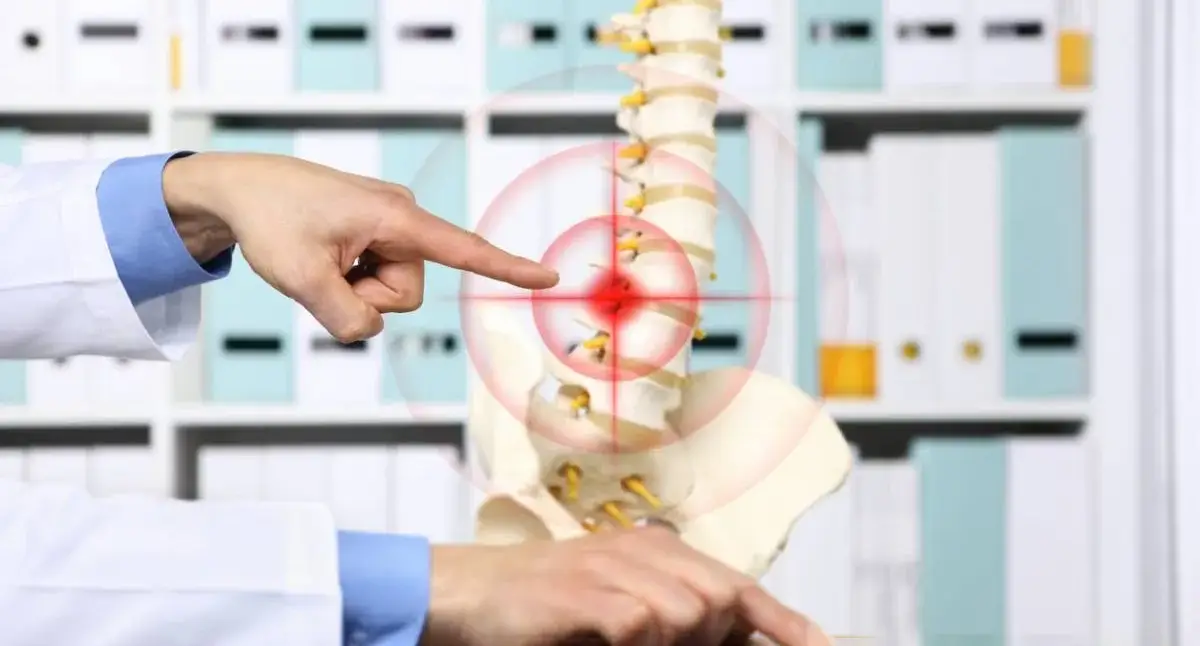



Many herniated discs improve with time and conservative care, but persistent radiating pain, numbness, or weakness may signal nerve compression that should be evaluated by a specialist.





You twist to load the trunk, bend to pick up a child, or sit through a long drive—and suddenly there’s a sharp pull in your low back or neck. Over the next day, the pain may start traveling into your leg or arm, or your foot or fingers may feel numb in a way you can’t ignore. When an MRI report mentions a “herniated disc,” a common question comes next: can a herniated disc heal itself, or is surgery inevitable?
For many people, symptoms improve with the right non-surgical plan. The more important issue is knowing whether your symptoms fit a typical recovery pattern, what tends to slow healing, and which signs suggest the nerve is under enough pressure that you should be evaluated sooner.
Your spine is made of vertebrae stacked on top of each other, with a disc between each level. Discs work like shock absorbers and spacers, allowing smooth motion while helping protect nearby nerves.
Each disc has a durable outer layer (annulus) and a softer center (nucleus). A herniated disc occurs when part of that softer center pushes through a weak spot or tear in the outer layer. The disc material itself is not the problem for everyone—some herniations cause no symptoms at all. Pain usually starts when the herniation triggers inflammation around a nerve root or physically compresses it, leading to radiating pain, tingling, or weakness.
If you’re trying to make sense of overlapping diagnoses (disc bulge vs. arthritis vs. stenosis), reviewing common spine conditions can help you understand how different problems can produce similar symptoms.
Often, yes—at least in the practical sense that symptoms can resolve or become manageable without surgery. Many herniated-disc flare-ups improve as inflammation settles and the irritated nerve calms down. Over time, the body may also break down and reabsorb some of the herniated disc material.
Still, “heal itself” can be misleading. Discs do not regenerate like skin, and improvement is rarely instant. Most patients feel better gradually, with good days and bad days along the way. The goal is to reduce pain and nerve irritation, keep you safely moving, and rebuild strength so a disc flare-up doesn’t keep recurring.
Another important point: MRI findings and symptoms do not always match perfectly. Some people have a large herniation and minimal symptoms, while others have significant nerve pain from a smaller herniation. That’s why a hands-on exam and a careful symptom history matter as much as imaging.
A herniated disc can cause local pain (neck or low back) and/or nerve-root symptoms that travel into an arm or leg. Many patients are surprised that the worst pain may be in the calf, foot, hand, or fingers—not in the spine itself.
If your symptoms sound like nerve involvement, it can be helpful to read about pinched nerve treatment and how specialists determine whether symptoms are coming from the spine.
Some symptoms are not appropriate for watchful waiting. Seek urgent evaluation if you develop:
Many herniated disc episodes improve meaningfully within several weeks, especially when inflammation is the main driver of symptoms. Nerve-related symptoms—like tingling, numbness, or a “buzzing” sensation—often take longer to settle than back or neck pain.
Improvement tends to look like: less frequent pain spikes, increased walking tolerance, better sleep, and a gradual return to normal daily activities. Plateauing or worsening symptoms can be a sign that the nerve remains irritated or compressed in a way that may benefit from more targeted treatment.
If pain continues to interfere with essentials—walking, working, driving, or sleeping—or if you notice true weakness, it’s reasonable to get a specialist evaluation rather than trying to push through.
Some people can point to a clear trigger such as lifting something heavy, a fall, or a sports injury. Others notice symptoms after a period of prolonged sitting, repetitive bending, or simply “sleeping wrong.”
Common contributors include:
When leg pain is the dominant symptom, learning how sciatica treatment works can clarify why nerve pain behaves differently than muscle strain and why sitting can aggravate it.
Most patients start with a structured conservative plan aimed at calming the nerve, restoring motion, and rebuilding support around the spine. Treatment is typically tailored to your symptoms, exam, and imaging, and may include:
The goal is not indefinite rest. In many cases, gentle movement—especially walking—helps recovery more than staying in bed, as long as you avoid positions that repeatedly flare symptoms.
Surgery is not the default for a herniated disc. But it can be appropriate when symptoms and exam findings suggest significant nerve compression, or when quality of life remains limited despite a reasonable course of non-surgical care.
A spine specialist may discuss procedural or surgical options when:
A common minimally invasive operation for disc-related nerve compression is a discectomy, which removes the portion of disc pressing on the nerve. Learn more about spinal discectomy surgery and how it’s used for carefully selected patients.
It’s also worth clearing up a frequent point of confusion: kyphoplasty is designed to treat certain painful vertebral compression fractures, not a typical herniated disc.
If you’re asking whether a herniated disc can heal itself, you’re already focused on the right priority: pursue the least invasive plan that fits your condition, and escalate only when the nerve and your function aren’t improving. At Yashar Neurosurgery, Parham Yashar, MD takes time to connect your symptoms with your exam and imaging so you understand what’s driving your pain and what options make sense—from guided conservative care to minimally invasive spine surgery when appropriate.
If you’re dealing with radiating arm or leg pain, numbness, or weakness and want a clear plan from the best minimally invasive spine surgeon in Los Angeles, call Yashar Neurosurgery at (424) 209-2669 or request an appointment at 8436 W. 3rd Street, Suite 800, Los Angeles, CA 90048.




Please complete and submit the form below and a member of our staff will contact you shortly.