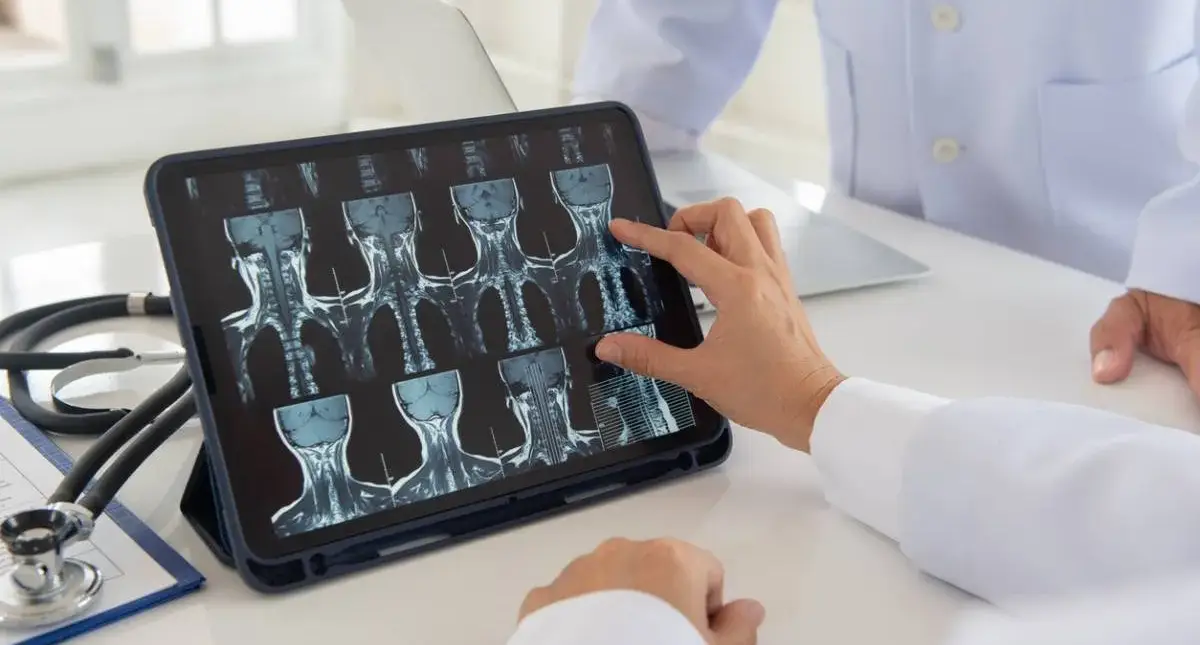



Spine tumors are uncommon, but progressive pain, night symptoms, numbness, weakness, balance changes, and bowel or bladder issues are red flags that deserve prompt evaluation.





Most back and neck pain is caused by everyday problems like a strained muscle, arthritis, or a disc issue. What can be unsettling is when the symptoms don’t behave like “normal” back pain—pain that keeps getting worse, wakes you up at night, or is paired with new numbness, weakness, or balance changes.
Spine tumors are uncommon, and many people with these symptoms will ultimately have a non-tumor explanation. Still, knowing the less obvious warning signs can help you seek the right evaluation sooner—especially when symptoms are progressive or don’t match what you’ve experienced before.
Spine tumors are abnormal growths that develop within the spinal canal (near the spinal cord or nerves) or in the bones that make up the spine. They can be benign (non-cancerous) or malignant (cancerous).
Doctors often describe spine tumors as:
Symptoms develop when a tumor irritates, compresses, or destabilizes the structures of the spine—most importantly the spinal cord and the nerve roots. Because those nerves control sensation, strength, walking, and bowel/bladder function, pressure in the wrong location can create symptoms that seem unrelated at first.
For context, many non-tumor problems can cause similar complaints. If you’re trying to sort through possibilities, our overview of spine conditions can be a helpful starting point.
The symptoms of a spine tumor depend on where it is (neck, mid-back, or low back), whether it involves bone, the spinal cord, or a nerve root, and how quickly it’s growing. Some people notice pain first; others notice neurologic changes first. The “hidden” part is that early symptoms may resemble a pinched nerve, sciatica, or spinal stenosis.
Back pain alone is rarely enough to point to a tumor. The pattern is what raises concern. Pain is more suspicious when it:
Night pain can happen for reasons other than tumors, but pain that repeatedly wakes you up or steadily intensifies deserves a closer look.
Irritation or compression of a spinal nerve root can cause numbness, tingling, or burning that travels into an arm/hand or leg/foot. Many people assume this is “just a pinched nerve.” It may be—but symptoms that are new, spreading, or worsening are worth evaluating, especially if they’re paired with weakness.
Weakness doesn’t always feel dramatic. It can show up as:
Because weakness can creep in slowly, people often adjust their routines without realizing the change is progressing.
If a tumor compresses the spinal cord (not just a single nerve root), it can affect coordination and walking. Some people describe a new unsteadiness, trouble with quick turns, or feeling less stable on uneven ground. Spinal cord symptoms are time-sensitive because neurologic function can become harder to recover if compression continues.
New bowel or bladder problems can occur if the nerves that control these functions are affected. If you notice new incontinence, urinary retention, or numbness in the groin/saddle area—especially with back pain, leg symptoms, or weakness—seek urgent medical care.
Depending on tumor location and which nerves are involved, some people experience sexual dysfunction, including erectile dysfunction. Many non-spine causes exist, but new sexual dysfunction alongside neurologic symptoms (numbness, weakness, or bowel/bladder changes) should be discussed with a clinician promptly.
Tumors involving the vertebrae can weaken bone and contribute to deformity or instability. This may show up as escalating mechanical pain, a visible change in posture, or pain that worsens with standing and improves with lying down. In certain cases, weakened vertebrae can fracture, which can intensify pain and neurologic symptoms.
For many primary spine tumors, the exact cause isn’t known. Some may be associated with genetic conditions, but most people do not have a clear trigger.
Secondary (metastatic) spine tumors occur when cancer elsewhere spreads to the spine. In the original draft, lung and breast cancer were noted as common sources of secondary tumors. If you have a history of cancer and develop new, persistent back pain or neurologic symptoms, it’s reasonable to ask whether spine imaging is appropriate.
A careful diagnosis usually starts with two things: (one) a detailed history (how symptoms started, how they’re changing, what makes them better or worse) and (two) a focused neurologic exam (strength, sensation, reflexes, coordination, and gait).
Because tumor symptoms can overlap with common degenerative problems, imaging is often what clarifies the situation. Depending on your symptoms and exam, testing may include:
In some situations, a biopsy is recommended to determine tumor type and guide treatment. Occasionally, a spine tumor is found incidentally when imaging is done for another reason.
Treatment depends on the tumor’s type (benign vs. malignant), location, whether it’s primary or metastatic, and whether it is compressing the spinal cord or nerves. The goals are typically to protect neurologic function, relieve pain, and address the tumor itself.
Depending on the case, treatment may include:
If surgery is being considered, patients often want to know whether a less disruptive approach is possible. In appropriately selected cases, minimally invasive spine surgery techniques can reduce muscle disruption while still addressing compression or instability. Your surgeon will recommend an approach based on the tumor’s anatomy and the safest path to the spinal canal.
For a broader view of operative options and decision-making, you can also review our spine surgery hub.
Consider a spine or neurosurgical evaluation when symptoms are persistent, progressive, or don’t fit the pattern of typical mechanical back pain. It may be time to be seen if you have:
Even when the cause is not a tumor, these symptoms can signal other conditions that benefit from timely treatment.
When symptoms are concerning, the goal is clarity: identifying whether you’re dealing with a tumor, a degenerative spine problem, or another neurologic condition—and then mapping out a plan that protects function and quality of life.
At Yashar Neurosurgery in Los Angeles, Parham Yashar, MD, provides thoughtful evaluation, careful review of imaging, and clear guidance on next steps, including non-surgical care when appropriate and surgical planning when needed. Because our practice also evaluates a wide range of neurologic diagnoses, including complex brain conditions, we’re well positioned to help when symptoms overlap and the answer is not obvious at first.
If you’re looking for the best minimally invasive spine surgeon in Los Angeles for an expert opinion on possible spine tumor symptoms or an unexpected MRI finding, call Yashar Neurosurgery at (424) 209-2669 to schedule a consultation.




Please complete and submit the form below and a member of our staff will contact you shortly.